

Science of Homeopathy
The case for homeopathy, made from the evidence.
Think homeopathy has no science behind it? Let's look at what the peer-reviewed research actually says — the trials, the meta-analyses, the clinic data, and yes, the honest questions that remain too. This is the defense, built from primary sources you can check yourself.
The case for homeopathy
If you've heard that homeopathy is “just placebo” or “has no scientific evidence,” you've heard the prosecution's closing line — but have they offered you any proof? Let's put the evidence on the table. The claim that homeopathy has no scientific support is simply not accurate. Researchers have run randomized, double-blind, placebo-controlled trials — the same gold-standard design used to test conventional drugs — which reported statistically significant results in favor of homeopathy, published in mainstream journals like The Lancet, BMJ, and Chest.
What follows draws on three kinds of evidence: placebo-controlled trials and the meta-analyses that pooled them; the clinical outcomes data from the Banerji Homeopathic Research Foundation and large observational studies; and basic-science research testing whether ultradilute preparations can produce measurable effects at all. None of it is anecdote. All of it is published, peer-reviewed, and verifiable.
89
placebo-controlled trials pooled in the 1997 Lancet meta-analysis
2.45×
combined odds ratio favoring homeopathy in that analysis
~70%
positive outcome rate reported across the Banerji clinic cases
What the meta-analyses found
A single trial can be a fluke. That's why scientists pool many trials into a meta-analysis — a statistical combination that looks for an effect across the whole body of evidence. When independent teams did this with homeopathy, the result was striking and remarkably consistent.
Kleijnen et al. — the 1991 BMJ review
One of the first major reviews in a top leading medical journal of the existing homeopathic research concluded that when they sorted the trials by quality, the better-designed studies were the ones most likely to report positive results for homeopathy. They therefore concluded that homeopathy deserved serious scientific attention rather than being dismissed outright.
A 1991 BMJ review by Jos Kleijnen and colleagues set out to do something unusual for its time: take the homeopathy clinical-trial literature seriously and judge it by the same standards used to evaluate conventional medicine. The team searched the published research and identified dozens of controlled trials of homeopathy, then rated each one on methodological quality — looking at whether it used randomization, blinding, adequate sample sizes, and pre-defined outcome measures.
Their central finding was striking. When they sorted the trials by quality, the better-designed studies were the ones most likely to report positive results for homeopathy. In other words, the trials that did the most to rule out bias and chance were the ones where homeopathy appeared to work — the opposite of what you would expect if the positive findings were simply the product of sloppy research.
The review covered a wide range of conditions, and several of the higher-quality trials stood out. In trials of homeopathic treatment for respiratory infections and hay fever, patients receiving homeopathy improved more than those on placebo. Trials on postoperative recovery and pain also reported positive results, as did studies looking at conditions such as rheumatologic complaints. The pattern repeated across different ailments and different research teams, which made it impossible to dismiss the findings.
Kleijnen and his co-authors concluded that the existing evidence was strong enough to deserve serious scientific attention and properly funded further research.
That mattered because it came from mainstream academic reviewers writing in one of the world's leading medical journals. As with later reviews, its conclusions depend on the trials available at the time, their quality, and the methods used to combine them — but its core message, that well-designed homeopathy studies were promising enough to take seriously, even when held to the most rigorous standard helped set the stage for the larger meta-analyses that followed.
Published source
Kleijnen J, Knipschild P, ter Riet G. “Clinical trials of homoeopathy.” BMJ, 1991; 302(6772):316–323.
View in BMJIf results in favor of homeopathy were the better-designed studies with more rigorous standards, could a homeopathic remedy help you?
Find remedies for over 130 different symptoms with the Sol Remedy FinderFor educational purposes only.
The 1997 Lancet meta-analysis of 89 trials
The 1997 Lancet meta-analysis pooled 89 placebo-controlled trials, and homeopathy outperformed placebo with a combined odds ratio of 2.45 — about two-and-a-half times more often than chance would predict. Crucially, when the analysis was restricted to only the highest-quality, best-designed trials, homeopathy still performed significantly better than placebo. That matters: the studies least vulnerable to bias and chance were the ones where homeopathy's effect held.
Klaus Linde and colleagues identified 186 placebo-controlled trials of homeopathy, of which 89 had enough reported data for the main quantitative analysis. In those studies, the combined odds ratio was found to be 2.45 (95% confidence interval 2.05–2.93) in favor of homeopathy outperforming the placebo. The authors concluded that the effects could not be attributed to placebo alone.
Variation in study quality is a factor in all scientific studies, pharmaceutical drug or homeopathic remedy alike. To further clarify the results of their meta-analyses, researchers then restricted their analysis to trials rated highest in methodological quality. The result remained in favor of homeopathy at an odds ratio of 1.66, with a wider confidence interval.
The Linde team found that the largest, most rigorous synthesis of the evidence available at the time found a real signal that survived quality-filtering. Homeopathy was not just a placebo.
Published source
Linde K, Clausius N, Ramirez G, et al. “Are the clinical effects of homoeopathy placebo effects? A meta-analysis of placebo-controlled trials.” The Lancet, 1997; 350(9081):834–843. PMID 9310601.
View on PubMedWhen nearly 90 controlled trials pooled together still pointed in homeopathy’s favor, is it worth seeing whether a homeopathic approach could help with a health concern you’re navigating?
Explore remedies for your symptoms with the Sol Remedy FinderFor educational purposes only.
Cucherat et al. — the 2000 pooled analysis
A separate European team pooled the randomized trials a different way and still found a statistically significant combined effect in favor of homeopathy. Two independent groups, two methods, the same direction — which is exactly the kind of replication science asks for.
When Linde's Lancet paper drew scrutiny, a separate group led by Cucherat and Boissel re-analyzed the homeopathy trial literature using different statistical methods. Pooling the randomized controlled trials, they too reported a statistically significant combined effect favoring homeopathy over placebo.
For our purposes the point is simple: when two independent research teams apply different methods to the same body of trials and both find a significant effect in the same direction, that is convergent evidence. It makes “there is no evidence that homeopathy works” an indefensible claim.
Published source
Cucherat M, Haugh MC, Gooch M, Boissel JP. “Evidence of clinical efficacy of homeopathy. A meta-analysis of clinical trials.” European Journal of Clinical Pharmacology, 2000; 56(1):27–33. PMID 11202726.
View sourceIf homeopathy is gentle, safe, and affordable and shown to be more effective than placebo, could it help you?
Browse top remedies for acute and chronic diseases with the Sol Remedy FinderFor educational purposes only.
The placebo-controlled trials, one by one
Meta-analyses tell you the big picture; individual trials tell you the symptomatic proof. Here are just five examples of double-blind, placebo-controlled trials — the same design used to approve conventional medicines — in which homeopathic treatment outperformed placebo on measurable outcomes. Each is published in a peer-reviewed journal, and each source links to the original paper so you can read it yourself.
Reilly et al. — allergic asthma (Lancet, 1994)
People with allergic asthma were given either homeopathic dilutions of their specific triggers or a dummy pill (placebo). Neither the patients nor the doctors knew who got what, and the treatment followed a fixed, standardized schedule. The homeopathy group breathed more easily and felt better than the placebo group — measured both by how people felt and by objective, blinded checks. This study showed the efficacy of homeopathic treatment for allergic asthma.
A team led by Dr. David Reilly at Glasgow Royal Infirmary ran a randomized, double-blind, placebo-controlled trial of homeopathic dilutions of allergens in patients with allergic asthma. The trial was designed to test whether homeopathic treatment could produce measurable effects under rigorous, controlled conditions.
The study's strength lay in its careful parameters: explicit inclusion criteria, a fixed treatment schedule using standardized ultramolecular dilutions of the same allergens that triggered each patient, and outcome measures — both subjective visual-analogue scales and objective blinded assessments — specified in advance. By holding these conditions constant and comparing against a placebo group treated identically except for the active dilution, the investigators could isolate whether the homeopathic preparation itself made a difference.
The homeopathy group showed statistically significant improvement in both subjective and objective measures compared with placebo. Because the improvements showed up not only in how patients felt but also in objective, blinded assessments, the result could not be attributed to expectation or suggestion alone.
By meeting a high standard of controlled comparison, double blinding, standardized treatment, and pre-specified outcome measures, the Reilly trial demonstrated the efficacy of homeopathic dilutions for allergic asthma.
Published source
Reilly DT, Taylor MA, Beattie NG, et al. “Is evidence for homoeopathy reproducible?” The Lancet, 1994; 344(8937):1601–1606. PMID 7983994.
View sourceCould exploring natural and affordable homeopathic remedies for asthma help you or someone you love?
Find top natural remedies for asthma with the Sol Remedy FinderFor educational purposes only.
Taylor et al. — perennial allergic rhinitis (BMJ, 2000)
Fifty people with year-round dust-mite allergies got either homeopathic dust-mite dilutions or a placebo. Instead of just asking how people felt, researchers measured actual airflow through the nose. The homeopathy group could breathe through their noses noticeably better than the placebo group — an objective, measurable improvement.
Taylor and colleagues published a randomized, double-blind, placebo-controlled trial of homeopathic house-dust-mite dilutions in patients with year-round allergic rhinitis. Fifty patients completed the study.
The homeopathy group showed a significant objective improvement in nasal airflow compared with placebo, measured by peak nasal inspiratory flow rather than subjective symptoms alone. The paper also reviewed four related trial series.
Published source
Taylor MA, Reilly D, Llewellyn-Jones RH, et al. “Randomised controlled trial of homoeopathy versus placebo in perennial allergic rhinitis with overview of four trial series.” BMJ, 2000; 321(7259):471–476. PMID 10948025.
View sourceCould a gentle, natural approach be worth exploring for your own allergy congestion?
Find remedies for allergies and sinus congestion with the Sol Remedy FinderJacobs et al. — acute childhood diarrhea (Pediatrics, 1994; 2003)
In three separate trials across different countries, young children with acute diarrhea recovered faster with homeopathic treatment than with a placebo. All three studies produced the same consistent result across 242 children, demonstrating the efficacy of homeopathic treatment for acute childhood diarrhea.
Dr. Jennifer Jacobs and colleagues ran a randomized, double-blind, placebo-controlled trial in Nicaragua. Children receiving individualized homeopathic treatment had a statistically significant decrease in the duration of diarrhea compared with placebo.
Two further double-blind trials were conducted, and a 2003 meta-analysis combined all three trials, totaling 242 children aged 6 months to 5 years. The pooled analysis reported a shorter duration of acute childhood diarrhea across all three studies when using the homeopathic treatment over placebo.
Published source
Jacobs J, Jonas WB, Jiménez-Pérez M, Crothers D. “Homeopathy for childhood diarrhea: combined results and metaanalysis from three randomized, controlled clinical trials.” Pediatr Infect Dis J, 2003; 22(3):229–234. PMID 12634583.
View sourceCould a homeopathic option be a comforting addition to your family’s care toolkit?
Find remedies for diarrhea and digestive upset with the Sol Remedy FinderFor educational purposes only.
Bell et al. — fibromyalgia (Rheumatology, 2004)
Sixty-two adults with fibromyalgia — a condition of long-lasting, widespread pain — received either a homeopathic remedy chosen for them personally or a placebo. The homeopathy group had less pain at their tender points and reported better quality of life and overall health than the placebo group.
Iris Bell and colleagues at the University of Arizona conducted a double-blind, randomized, parallel-group, placebo-controlled trial of individualized homeopathy in 62 adults with physician-diagnosed fibromyalgia.
The study reported that individualized homeopathy was significantly better than placebo in lessening tender-point pain and improving quality-of-life and global-health ratings. It was designed to replicate and extend an earlier placebo-controlled study.
Published source
Bell IR, Lewis DA, Brooks AJ, et al. “Improved clinical status in fibromyalgia patients treated with individualized homeopathic remedies versus placebo.” Rheumatology, 2004; 43(5):577–582. PMID 14734789.
View sourceCould homeopathic support offer lasting pain relief for your symptoms?
Find remedies for pain and fibromyalgia with the Sol Remedy FinderFrass et al. — ICU tracheal secretions (Chest, 2005)
Critically ill patients on ventilators in a hospital intensive-care unit were given either homeopathic potassium dichromate or a placebo. The homeopathy group had less thick, sticky mucus clogging their breathing tubes — a practical, potentially life-saving benefit in a setting where every breath matters.
Dr. Michael Frass and colleagues at the Medical University of Vienna ran a prospective, double-blind, randomized, placebo-controlled study in an intensive-care unit, testing homeopathic potassium dichromate against placebo in critically ill patients with COPD being weaned from artificial ventilation.
The homeopathy group showed a significant reduction in stringy tracheal secretions. The authors concluded that potentized potassium dichromate may help in this setting and called for further research.
Published source
Frass M, Dielacher C, Linkesch M, et al. “Influence of potassium dichromate on tracheal secretions in critically ill patients.” Chest, 2005; 127(3):936–941. PMID 15764779.
View sourceIf a homeopathic preparation eased thick, stubborn airway secretions even in critically ill ventilated patients, could it offer supportive respiratory comfort in everyday illnesses?
Find remedies for cough and respiratory congestion with the Sol Remedy FinderFor educational purposes only.
The Banerji Protocols: a century of measured outcomes
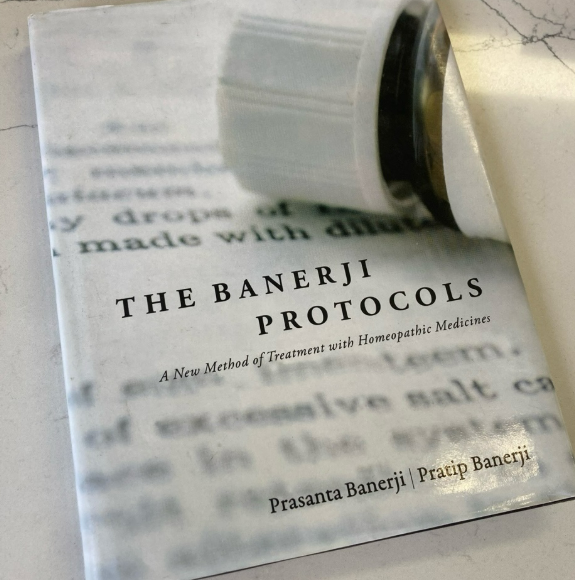
The best evidence does not come from a single trial, no matter how well controlled or blinded. Some of the most compelling data in favor of homeopathy comes from the Banerji Protocols — a standardized, disease-specific system of homeopathic prescribing developed by four generations of medical doctors within the Banerji family in India. At the height of their homeopathic clinic's activity, more than a thousand patients a day came through its doors, and every patient, remedy, and outcome was logged.
That case-recording tradition became one of the largest bodies of homeopathic clinical evidence ever assembled. The Prasanta Banerji Homeopathic Research Foundation (PBHRF), established in 1993, formalized this data and began collaborating with mainstream medical institutions — most notably MD Anderson Cancer Center at the University of Texas and the National Cancer Institute (NCI).
After reviewing the Foundation's documented cases, the NCI added two Banerji Protocol remedies — Carcinosin and Phytolacca — to its Best Case Series Program, the institute's formal pathway for evaluating promising non-conventional cancer therapies. That level of engagement from a leading cancer research institution is historically unprecedented for homeopathy.
Across its treated population for all symptoms and diseases — which was skewed toward the most difficult cases, as it frequently included patients who had already exhausted conventional options — the PBHRF reported positive outcome rates in their patients of approximately 70%. Does a 70% positive outcome rate across more than 200 standardized disease protocols, replicated over hundreds of thousands of independently treated patients lead you to believe there is no evidence that homeopathy is effective?
Why standardization matters
The Banerji Protocols assign a fixed remedy-and-potency combination to each condition, applied consistently and measured for results. That removes the variability that makes classical homeopathy hard to study — and it's exactly what let independent institutions evaluate the work fairly.
The Ruta 6 brain-cancer research
In laboratory work published in an integrative oncology journal, a Banerji Protocol remedy combination (Ruta graveolens 6C and Calcarea Phosphorica 3X) was reported to selectively kill brain cancer cells while leaving normal immune cells unharmed — and the clinic documented tumor regression in patients treated with the same protocol. That's the holy grail of cancer therapy: harm the cancer, spare the patient.
The Banerji team's most widely cited laboratory research examined the effect of Ruta Graveolens 6C — a homeopathic preparation of the flowering plant Rue — on human brain cancer cells. In a study published in Integrative Cancer Therapies, the authors reported that Ruta 6C selectively induced cell death in brain cancer cell lines while normal human lymphocytes continued to proliferate. In plain terms: the remedy appeared to kill the cancer cells and leave healthy immune cells alone.
Alongside the laboratory work, the clinic documented clinical cases of tumor regression — including in glioma (brain tumor) patients — treated with the Ruta 6C and Calc Phos 3X protocol. These cases were among those reviewed through the NCI Best Case Series process. They showed elective cancer-cell killing in a controlled lab dish, paired with consistent clinical observation, convergent evidence pointing towards potential alternative or supportive options to cancer care.
Published source
Pathak S, Multani AS, Banerji P, Banerji P. “Ruta 6 selectively induces cell death of brain cancer cells but proliferates normal lymphocytes.” Integrative Cancer Therapies, 2003; 2(2):130–137. PMID 14636349.
View sourceNeed even more evidence of homeopathy's efficacy? Read on!
Witt et al. — outcomes in nearly 4,000 patients
When German researchers tracked almost 4,000 patients treated by homeopathic doctors under real-world conditions — not a controlled trial — they found that disease severity dropped and quality of life improved, with the biggest gains in the patients who were sickest to begin with. This is what homeopathy looks like outside the laboratory, in everyday practice.
Placebo-controlled trials have their place in scientific research, but none of us live under laboratory conditions. So can homeopathy really help improve health and vitality in the real world? In 2005, Witt and colleagues published a large observational study tracking 3,981 patients seen by homeopathic physicians in Germany and Switzerland under everyday practice conditions. The patients had a wide range of chronic complaints — allergies, headaches, skin conditions, and more.
Over the study period, the researchers documented a statistically significant decrease in disease severity and a measurable improvement in quality of life. The effect was largest in patients with the most severe baseline symptoms — the people conventional treatment had helped least.
Observational studies have a known weakness: without a control group, it's impossible to know for certain the outcome if homeopathy had not been used. But when a professional research group finds that large real-world dataset lines up with the controlled-trial evidence and the clinic data, it becomes increasingly difficult to agree that homeopathy is not supported by science. No single study on any type of medical care should ever carry the whole argument, but when all the data is examined and taken together, it becomes clear. Homeopathy can have a measurable improvement on health outcomes.
Published source
Witt CM, Lüdtke R, Baur R, Willich SN. “Homeopathic medical practice: long-term results of a cohort study with 3981 patients.” BMC Public Health, 2005; 5:115. PMID 16174285.
View sourceWhether the gains came from directly from the remedy or the associated placebo effect — a statistically significant number of people saw their quality of life improve just from trying homeopathy. What could trying it do for you?
Find remedies to help manage symptoms of chronic disease with the Sol Remedy FinderFor educational purposes only.
Basic science: how can ultradilute preparations do anything?
Here's the genuinely fascinating puzzle at the heart of homeopathy: many of its remedies are diluted so far that, by chemistry's usual rules, not a single molecule of the original substance should remain. And yet, in well-conducted lab experiments, a majority of ultradilute preparations still produced measurable effects. We don't yet know exactly how that works — and that open question is one of the most interesting things about it.
The most common scientific objection to homeopathy isn't about the clinical trials — it's about chemistry. Many homeopathic remedies are diluted beyond Avogadro's number, meaning they likely contain not a single molecule of the original substance. So how on earth could they do anything at all? It's a wonderful question, and honestly, it's the kind of mystery that makes science fun.
Rather than shrug it off, researchers have rolled up their sleeves and asked the question directly in the lab. A 2007 systematic review by Witt and colleagues examined in vitro experiments testing ultradilute homeopathic preparations. They found that around two-thirds of the studies reported effects from the ultradilute preparations — and, fascinatingly, the positive findings were more common in the higher-quality studies.
Other lines of basic research have added to the intrigue. Work by Endler and colleagues on ultradilute thyroxine and amphibian metamorphosis, for example, has reported biological effects at dilutions where no molecules should remain. None of this yet adds up to a settled mechanism. While theories abound, we still don't have a clear answer on how homeopathy works — and yet, the science shows that it does. What remains is a genuinely open scientific question: something measurable is happening, and we get to keep asking why and how. Just because science hasn't found the answer yet, doesn't make the results any less real for 400 million people around the world who currently choose to use homeopathy to help manage their health.
Published source
Witt CM, Bluth M, Albrecht H, Weißhuhn TE, Baumgartner S, Willich SN. “The in vitro evidence for an effect of high homeopathic potencies—A systematic review of the literature.” Complementary Therapies in Medicine, 2007; 15(2):128–138. PMID 17544865.
View sourceReal evidence — published, peer-reviewed, verifiable
The studies on this page are not anecdotes: they are peer-reviewed, placebo-controlled research in mainstream medical journals, alongside clinical outcomes data and basic-science findings. Across the body of research gathered here, the result is consistent and statistically significant — published in mainstream medical journals, peer-reviewed, and verifiable. This is real evidence, not anecdote, and it stands as a serious, documented refutation of the claim that homeopathy is unsupported by science or merely a placebo.
Taken together, the peer-reviewed, placebo-controlled trials, the Banerji clinic's outcomes, the population-level data, and the basic-science research directly answer two common objections: that there is no scientific evidence supporting homeopathy, and that any benefit is just placebo. While more high-quality, well-powered trials would be a welcome addition to help identify exactly when and how homeopathy is most effective, given the amount of rigorously evaluated evidence available, it is impossible to conclude that homeopathy is ineffective or “merely” a placebo.
This is what it means to use modern homeopathy: you are not relying on folklore or intuition. You are drawing on a system built from over a hundred years of clinical observation, refined through outcomes measurement, and validated through some of the most rigorous research institutions in conventional medicine.
Homeopathy is gentle, safe, affordable and supported by a significant amount of scientific data. What is there to lose by trying it to find out if it could help you?
Find remedies with the Sol Remedy FinderFor educational purposes only.